Product formats.
New hydrogen formats, formulations and packaging ideas are evaluated through controlled conditions.
Read product development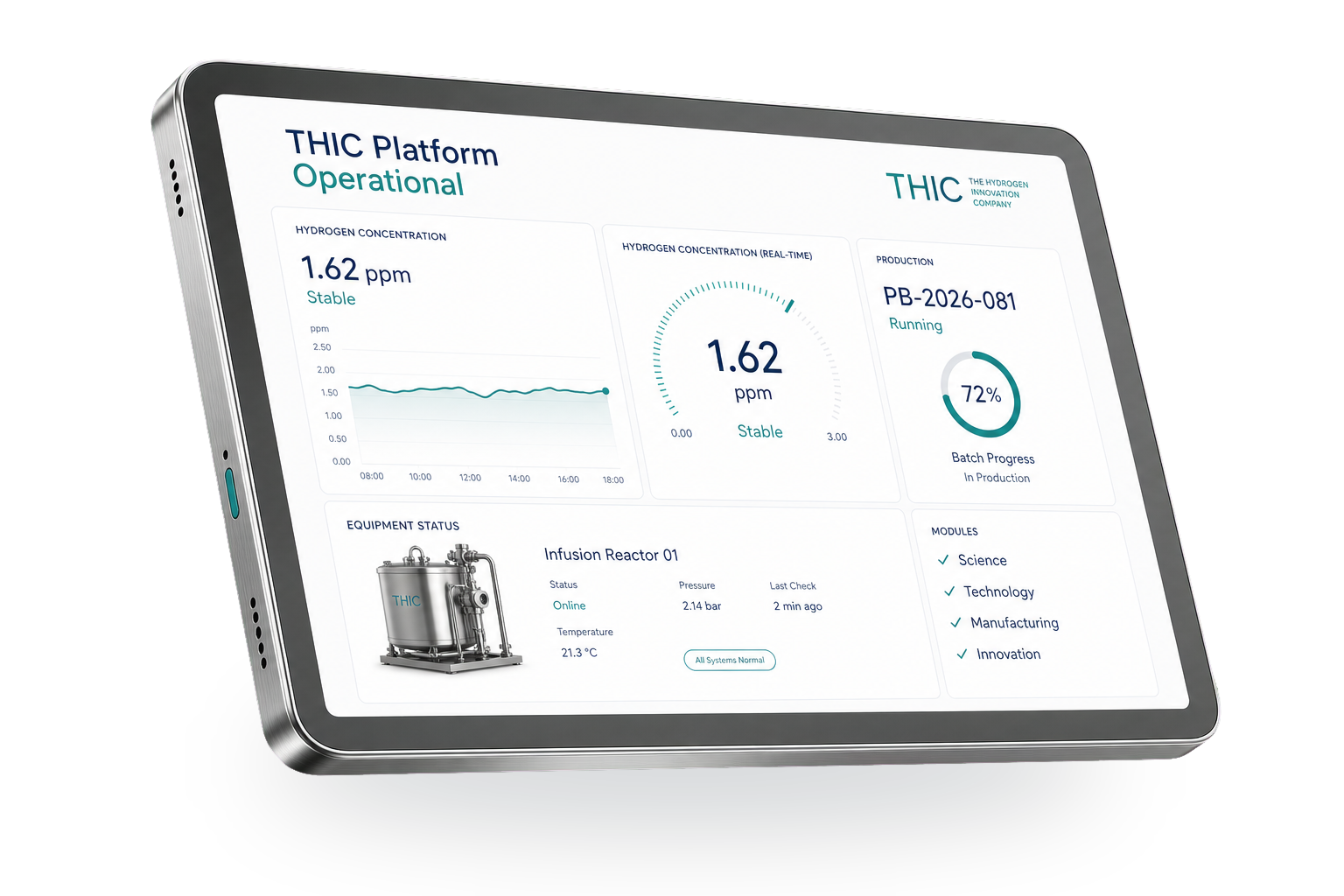
THIC does not treat every product, territory or partner opportunity as a blank-page experiment. The company builds from accumulated knowledge about water preparation, hydrogen concentration, stability, packaging behaviour, process control, batch execution and commercial readiness.
This makes innovation more disciplined. New ideas can be explored through existing scientific and manufacturing questions: what has to be measured, what has to be controlled, what must be documented and what conditions would make the result repeatable enough to develop further.
The innovation work connects technical knowledge to commercial pathways. It is creative, but it stays accountable to data, production reality and partner requirements.
New hydrogen formats, formulations and packaging ideas are evaluated through controlled conditions.
Read product developmentTHIC Hub connects Network, production, documentation and operational visibility behind the company.
Read digital systemsOEM, licensing and development programmes can use validated knowledge instead of isolated claims.
Read partner developmentHydrogen product development can involve new formats, functional formulations, packaging formats, application testing and commercial-readiness work. THIC evaluates those opportunities through the same questions used across the platform: what is the target, how is it measured, what process creates it and how can it be repeated?
The company avoids presenting unconfirmed products as launched outcomes. Ideas are developed through controlled trials, packaging assessment, process feasibility and commercial context so they can either mature into credible opportunities or be set aside with clear reasoning.
THIC Hub is the operating system behind the company. It connects Network relationships, production workflows, SOPs, batch records, finance, reporting and online activity so operational knowledge is not scattered across disconnected tools.
Digital systems matter because hydrogen technology depends on documentation. Production stages, measurements, deviations, follow-ups, partner enquiries and internal decisions should remain visible as part of one company record. That gives THIC a practical base for scaling without losing control of the details.
THIC can work with companies on product development, system development and commercial pathways where the opportunity benefits from hydrogen-specific knowledge. The aim is to define the technical and business question before committing resources to a format, territory or production model.
That scope can include product requirements, target applications, packaging considerations, manufacturing route, quality expectations, distribution context and the degree of THIC involvement required. A disciplined definition stage protects both the partner and the platform.
Companies exploring hydrogen-enabled formats, formulations or packaging directions.
Organisations developing equipment, production or commercial infrastructure around hydrogen applications.
Licensing is not presented as a promise that one document can transfer an entire technology platform. It may involve structured access to validated knowledge, technical systems, commercial rights, brand relationships or operating methods, depending on the opportunity and the agreement.
For licensing to be credible, the knowledge being transferred must be documented clearly enough to evaluate. THIC therefore connects licensing discussions to science, technology and manufacturing evidence, while leaving legal terms, territory rights and commercial obligations to formal agreement.
THIC’s intellectual-property strategy supports the future development and potential licensing of hydrogen-processing and controlled-filling technologies to selected partners. The European patent application remains pending and does not represent issued rights. Read the Technology IP context.
Hydrogen-related applications may develop across hydration, performance, wellness, manufacturing, packaging and digital tools. THIC keeps this exploration disciplined by avoiding unsupported product claims and focusing instead on the conditions that would make each application testable.
Some opportunities may require product trials, some may require manufacturing evaluation, and others may be better suited to software, documentation or partner infrastructure. The innovation platform allows THIC to assess these routes without reducing the company to one product format.
Evaluate product format, packaging, stability and user context.
Frame any evaluation around defined conditions and appropriate evidence.
Assess whether an application can be repeated in a controlled production flow.
Use software to preserve operational visibility, records and partner workflows.
Scientific and engineering work creates reusable foundations for future product formats, territories and partners. The value is cumulative: measurement methods, stability observations, process windows, packaging findings and production records can inform later decisions.
Define the technical question and the conditions being tested.
Measure the result and document variables that influence it.
Translate the finding into process design or system requirements.
Test whether the method can survive practical manufacturing conditions.
Use the evidence to evaluate products, partners and applications responsibly.
Innovation is where the full THIC platform becomes visible. Science defines what is known, Technology makes it work, Manufacturing makes it repeatable, and Innovation turns that combined knowledge into broader applications and commercial pathways.
The value is not novelty for its own sake. The value is the ability to keep learning, keep documenting and keep converting hydrogen knowledge into controlled systems that can support products, partners and future platforms with technical credibility.
Develop an Application or PartnershipCompanies, technical partners and institutions can work with THIC on product development, OEM concepts, digital systems, licensing routes or broader hydrogen application strategy where the opportunity benefits from measured knowledge and production-aware engineering.
Develop an Application or Partnership